




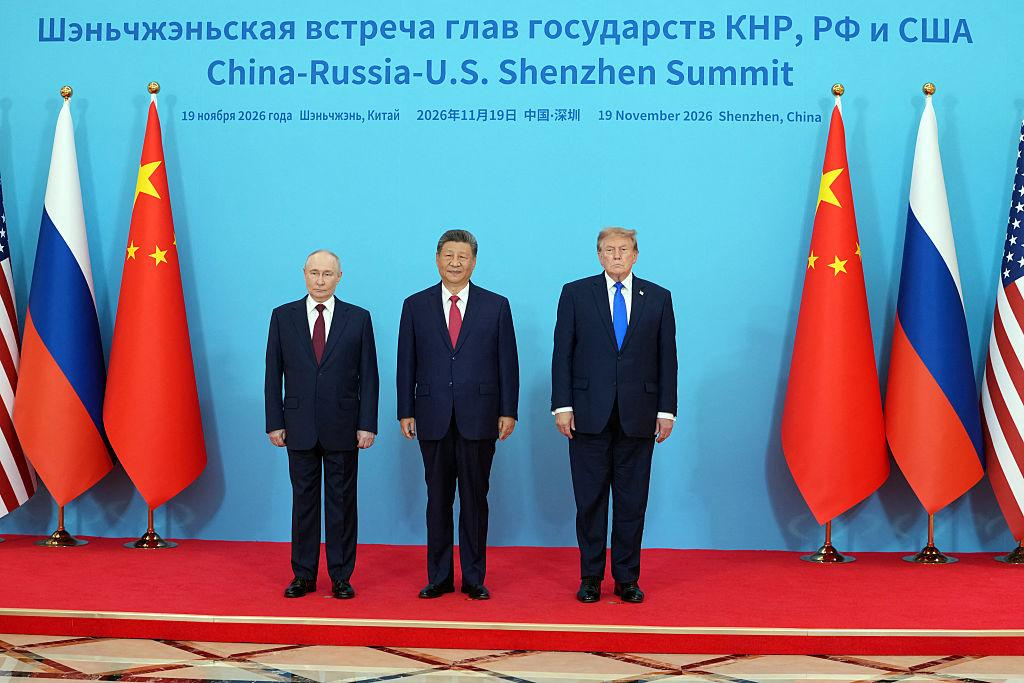
The leaders of the United States, China and Russia have issued a joint declaration calling for greater cooperation on global energy supplies, nuclear risk reduction and United Nations reform, following an unprecedented trilateral summit in the southern Chinese city of Shenzhen.
The meeting on November 19 brought together U.S. President Donald Trump, Chinese President Xi Jinping and Russian President Vladimir Putin, marking the first face-to-face summit involving the three countries’ leaders in this format.
The gathering took place alongside the Asia-Pacific Economic Cooperation (APEC) summit, providing a diplomatic setting for discussions on strategic stability, international security and economic uncertainty.
According to the joint declaration released following the meeting, the three governments agreed to pursue cooperation in four areas: United Nations reform, energy security, respect for state sovereignty and the reduction of nuclear risks.
Energy Security Takes Centre Stage
One of the summit’s most significant economic announcements was a commitment to increase the production and supply of refined petroleum products.
The declaration emphasized the importance of maintaining stable energy flows at a time when conflicts involving Russia and Iran have disrupted international markets.
The three leaders did not announce specific production quotas, binding supply commitments or a timetable for implementation.
Nevertheless, their joint position reflects concern that prolonged energy disruptions could undermine global economic stability.
For major energy-importing economies, including those in Asia and Europe, the prospect of greater coordination among three influential powers could have implications for supply security and market confidence.
Nuclear Powers Commit to Dialogue
The leaders also reaffirmed that nuclear war must never be fought and committed to discussions aimed at reducing nuclear risks and preventing the proliferation of nuclear weapons.
The declaration did not establish a new arms-control treaty or specify reductions in existing nuclear arsenals.
However, the commitment to dialogue comes amid tensions surrounding the war in Ukraine, Iran’s nuclear programme and broader strategic competition.
During the summit, Trump emphasized the responsibility of major nuclear powers to maintain communication and explore opportunities for arms reduction.
Putin highlighted the importance of international law and the United Nations framework, while Xi called for stable relations among major powers.
United Nations Reform and Sovereignty
The three governments also expressed support for reforming the United Nations to improve its ability to respond to international challenges.
The declaration did not outline a detailed institutional reform plan.
Another provision emphasized state consent and the immunities of government officials, while criticizing the potential misuse of jurisdiction by international judicial institutions.
The language reflected longstanding disagreements over the authority of bodies such as the International Criminal Court.
These positions may prove controversial among countries and international legal experts who advocate stronger accountability mechanisms.
Ukraine and Iran Remain Major Challenges
Despite the diplomatic significance of the meeting, the leaders did not announce comprehensive settlements to the wars and crises dominating international politics.
Trump said he had discussed the conflict in Ukraine with Putin and expressed hope that diplomatic progress could eventually lead to an end to the fighting.
Iran’s nuclear programme also featured in the discussions, with Trump reiterating his opposition to Tehran acquiring nuclear weapons.
The summit declaration, however, contained no detailed agreements resolving either issue.
A New Framework for Major-Power Relations?
The Shenzhen meeting represents an attempt to establish channels of cooperation among three governments whose interests frequently diverge.
China has emphasized dialogue and strategic stability, while Washington and Moscow continue to confront significant disagreements over European security and international sanctions.
The summit’s significance therefore lies partly in the willingness of the three leaders to engage directly.
Whether that dialogue produces lasting agreements will depend on subsequent negotiations and the implementation of the commitments announced in Shenzhen.
For the wider international community, the central question is whether the meeting marks the beginning of a more stable relationship among major powers or remains a limited diplomatic effort amid continuing geopolitical competition.