





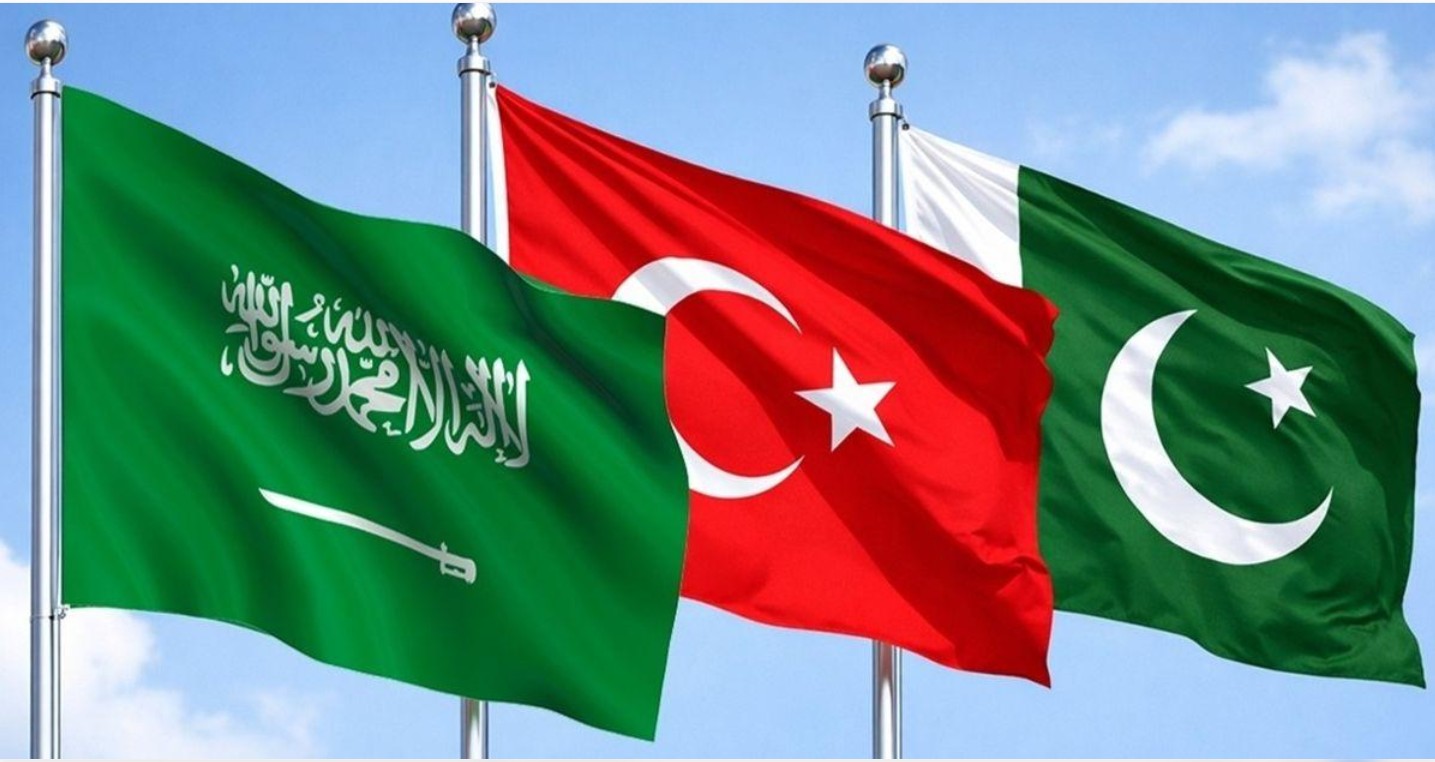
A new defense pact between Saudi Arabia, Türkiye and Pakistan could reshape regional cooperation, but its effectiveness will depend on whether political commitments translate into practical security arrangements.
The defense agreement signed by Saudi Arabia, Türkiye and Pakistan in Mecca on August 7, 2026, has renewed debate over whether Middle Eastern powers can develop a more independent regional security framework while maintaining their existing international alliances.
In an analysis published by the Policy Center for the New South, researcher Bilal Mahli argues that the agreement could mark an initial step toward a broader regional security architecture, although important questions remain about its implementation and the willingness of its members to act collectively during a crisis.
The pact is built around a collective defense commitment under which an attack against one signatory would be regarded as an attack against all three. However, the agreement’s long-term significance may depend less on that declaration than on the ability of the participating countries to establish lasting mechanisms for military and diplomatic cooperation.
Three Powers With Complementary Strengths
The agreement brings together countries with different but potentially complementary strategic capabilities.
Türkiye contributes a developed defense industry, an experienced military and membership in NATO. Pakistan brings substantial military capabilities and a nuclear deterrent, while Saudi Arabia provides economic resources and a strategic position near some of the world’s most important energy and maritime routes.
According to Mahli, these strengths could support cooperation in military training, defense technology, intelligence sharing, maritime security and defense manufacturing.
Such cooperation could be particularly significant at a time when instability around the Red Sea, the Bab el-Mandeb Strait and the Strait of Hormuz continues to influence regional security calculations.
For Saudi Arabia, protecting maritime trade routes and energy infrastructure is closely connected to its long-term economic ambitions.
A Shift Toward Regional Security Partnerships
The agreement also reflects Riyadh’s efforts to diversify its security relationships.
Saudi Arabia has traditionally relied heavily on the United States for defense cooperation. The emerging partnership with Türkiye and Pakistan does not necessarily signal a departure from that relationship.
Instead, Mahli suggests that the agreement could allow regional powers to assume greater responsibility for their own security while continuing to cooperate with Washington and other international partners.
The three countries do not share identical foreign policy priorities, which could complicate their cooperation. However, their differences may also encourage a pragmatic approach focused on specific security interests rather than ideological alignment.
The agreement should therefore not automatically be interpreted as an alliance directed against Iran, Israel or India.
The Challenge of Collective Defense
Despite its potential, the pact faces significant practical obstacles.
The central question is how the three governments would respond if one of them came under attack.
The agreement’s collective defense principle leaves unresolved issues concerning the definition of aggression, the type of assistance required and the circumstances under which military intervention might be considered.
National interests could also diverge during a regional confrontation.
Pakistan may be reluctant to become involved in a conflict with another Muslim-majority country, while Türkiye maintains its own strategic priorities. Saudi Arabia, meanwhile, has strong reasons to avoid becoming involved in another prolonged regional war.
These differences suggest that the agreement may initially prove more effective as a deterrent and a platform for diplomatic coordination than as a mechanism for conducting joint military operations.
Its success could ultimately be measured not only by its capacity to respond to threats, but also by its ability to prevent conflicts.
Could Other Countries Join?
Another important question concerns the agreement’s potential expansion.
Egypt stands out as a major regional power whose participation could significantly strengthen any future security arrangement, given its military capabilities, population and strategic location.
A broader framework might eventually attract other countries if it remains focused on defensive cooperation rather than competition with rival regional blocs.
However, expansion would require sustained diplomatic engagement and a shared understanding of regional security priorities.
There is also a risk that the agreement could reinforce existing divisions if it develops into an exclusive military alliance.
Mahli argues that a more constructive outcome would involve building cooperation among countries with different foreign policy objectives and, over time, creating opportunities for wider regional dialogue.
An Opening Rather Than a Finished Security System
The Mecca Agreement does not yet amount to a comprehensive regional security organization comparable to NATO.
Its institutional structures, operational procedures and long-term commitments remain important areas of uncertainty.
Nevertheless, the agreement represents an attempt by three influential powers to strengthen security cooperation in a region where defense arrangements have often depended on external actors or competing bilateral alliances.
Whether the initiative develops into a durable regional institution will depend on political commitment, military coordination, financial resources and the ability to manage disagreements among its members.
For now, the agreement offers a possible direction for regional security cooperation rather than a completed model.
Its longer-term importance will become clearer as Saudi Arabia, Türkiye and Pakistan confront the practical challenges of translating collective defense commitments into sustained cooperation.
This article is an editorial adaptation of an analysis by Bilal Mahli, published by the Policy Center for the New South on August 11, 2026. It is not a direct translation of the original publication.